
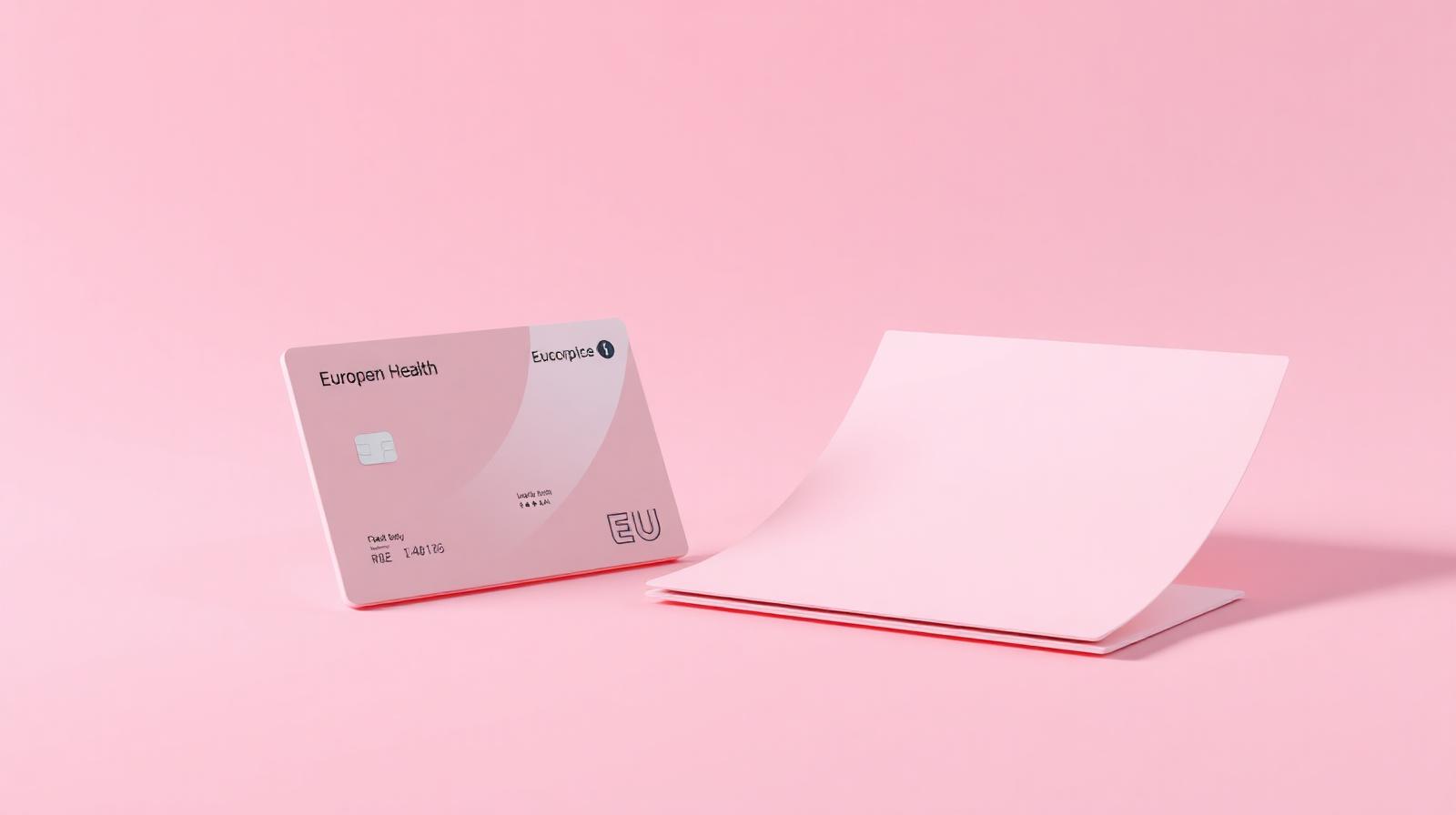
The three documents that matter
Before any country-specific paperwork, get clear on the three pieces of evidence that govern social-security treatment for any intern moving inside the EU/EEA. Each does a different job and they are not interchangeable.
- EHIC (European Health Insurance Card) — covers medically necessary public healthcare in any EU/EEA country. Free, issued by your home insurer.
- A1 Portable Document — proves you remain registered in your home country's social security system while working in another. Issued by your home social-security institution, typically valid 12–24 months.
- Host-country social security number (NUSS in Spain, Numéro de Sécurité Sociale in France, Numero INPS in Italy, Sozialversicherungsnummer in Germany, etc.) — required when the host enters you in local payroll.
Think of the EHIC as your healthcare passport, the A1 as your contributions passport, and the host-country number as your payroll identifier. Most Erasmus+ disputes happen when one of the three is missing and the host's accounting software simply refuses to proceed.
When you actually need a host-country number
The dividing line is payroll, not the visa. If money flows from a host-company bank account to yours under a local payroll system, the host's accountant will need a number to file contributions, even when those contributions are reduced for an Erasmus+ Convenio.
- Paid placement in Spain → NUSS required. The host requests it via Importass for unregistered foreigners.
- Paid placement in Portugal → NISS required. Apply at Segurança Social Direta before signing the IEFP-registered protocol.
- Paid placement in Italy → Codice Fiscale + Numero INPS required for the host to file the UniLav.
- Paid placement in Germany → not always required if you have an A1; otherwise the host requests a Sozialversicherungsnummer via the Krankenkasse.
- Paid placement in France → NIR (numéro provisoire) is issued automatically when the host declares the contract via the DPAE.
- Paid placement in the Netherlands → BSN (Burgerservicenummer) required for any contract over 4 months or any stipend over €350/month.
- Paid placement in Ireland → PPS Number required from week one of any paid contract, regardless of duration.
What the A1 does and does not do
The A1 keeps you in your home social-security scheme — your home country continues to collect contributions and you remain covered for pension and unemployment there. It does not exempt the host from local labour-law obligations (minimum stipend in France, minimum wage in Germany for placements over 3 months) and it does not replace the host-country social security number when the host needs to file contributions locally for accident insurance.
- Get the A1 from your home institution (URSSAF in France, INSS in Spain, INPS in Italy, ZUS in Poland, DRV in Germany, etc.) before you leave.
- Send a copy to your host the moment it is issued — many payroll systems are blocked without it.
- Validity is typically 12 months for posted workers and up to 24 months for students on traineeships.
If your home country refuses to issue an A1 (common for students who have never worked and therefore have no employer file), the host will treat you as a 'first-time worker' and enrol you in the local scheme from day one. This is not a problem — but you should ask your home institution for written confirmation of the refusal, which the host's payroll team will need on file.
Paid stipend vs unpaid Convenio — why it changes everything
Erasmus+ traineeships span a spectrum from purely unpaid academic placements to fully salaried trainee contracts that look indistinguishable from employment. Where you sit on that spectrum determines the entire social-security overlay.
- Unpaid Convenio — pure academic placement, no payroll, no contributions. EHIC + Erasmus+ insurance is sufficient in most countries.
- Stipend under the country threshold (e.g. <€350/month in NL, <€600/month in DE) — host treats it as a reimbursement, not income. No social-security number required in most cases.
- Stipend at or above the threshold — host runs it through payroll; the full host-country social-security number is required.
- Trainee contract (CDD stage, contratto di apprendistato, Praktikantenvertrag) — full employee treatment. Local number required from day one, A1 still recommended.
When in doubt, ask your host one question: 'Does payroll process my stipend or does accounts payable?' If it's payroll, you need the number; if it's accounts payable, you usually don't.
How to apply, by country
The mechanics differ sharply by country. In most cases the host initiates the request and you provide the supporting documents — but in Spain, Portugal and Ireland you usually attend in person.
- Spain (NUSS) — Importass online or in person at any Tesorería General de la Seguridad Social. Need NIE, passport, signed Convenio. 1–3 days.
- Portugal (NISS) — Segurança Social Direta with NIF, passport, signed protocol. Same day to 1 week.
- Italy (INPS) — host registers you via UniLav once you have a Codice Fiscale from the Agenzia delle Entrate.
- Germany (Sozialversicherungsnummer) — request via the Krankenkasse you join; some interns receive it automatically after registering address (Anmeldung).
- France (NIR provisoire) — issued by the host's URSSAF declaration; permanent NIR requires CPAM enrolment with a long-form birth certificate (apostilled if not EU).
- Netherlands (BSN) — issued at the Gemeente when you register your address; need passport, rental contract and (for non-EU) residence permit. Same-day issue in most towns, 1–2 weeks in Amsterdam.
- Ireland (PPS) — book an appointment at MyWelfare.ie or a PPS Centre; need passport, proof of address (utility bill or rental contract) and host's signed offer. 5–10 working days.
What happens to your contributions
A frequent worry is whether short Erasmus+ contributions are 'wasted'. They are not — EU social-security coordination is built precisely to avoid that.
- With an A1, contributions stay in your home country and count fully towards your home pension and unemployment record.
- Without an A1, contributions go to the host country. Under Regulation (EC) 883/2004, the host country must transfer the contribution record to your home institution on request when you return.
- Even very short contribution periods (1–6 months) are aggregated for pension purposes across the EU — none are lost.
- Unemployment rights stay attached to the country where you last worked under their scheme. If you finish a paid placement abroad and want to claim unemployment at home, transfer rights using form U1 within 7 days of return.
Departure checklist before you fly home
The week before your last day is the moment to close every administrative loop. Items left open from abroad take three times longer to resolve remotely.
- Request form U1 (history of insurance periods) from the host social-security institution.
- Request a P45 / certificate of employment from the host HR if any payroll was processed.
- Cancel any local private health insurance you bought to top up the EHIC.
- Deregister your address (Abmeldung in DE, Baja del Padrón in ES) where required — failing to do so triggers ongoing tax liabilities.
- Keep all payslips for at least 4 years — they are the only proof of contribution if the U1 is later disputed.
Common mistakes
- Assuming the EHIC replaces a host-country number — it covers healthcare only, not payroll.
- Starting the host-country application before securing the host's signed offer — most systems require the contract reference.
- Forgetting to request the A1 — once you arrive, retroactive issuance is slow and the host may insist on local registration in the meantime.
- Mixing up the Codice Fiscale (Italian tax ID) with the Numero INPS (Italian social security) — they are different documents from different ministries.
- Treating the EHIC as a private-insurance substitute — it does not cover repatriation, dental, or any private provider.
- Letting the A1 expire mid-placement without requesting an extension — payroll often freezes contributions until renewed.
Continue reading on Piktalent
Frequently asked questions
Continue exploring
Pages on the Piktalent site that go deeper on the topics covered above.
Destinations covered in this article
- Internships in SpainCountry overview where NUSS is required for paid placements.
- Internships in PortugalCountry overview where NISS is required for paid placements.
- Internships in ItalyCountry overview where Numero INPS is required for paid placements.
- Internships in GermanyCountry overview where the A1 often replaces the local SV-Nummer.
- Internships in FranceCountry overview where the NIR provisoire is auto-generated by URSSAF.
- Internships in the NetherlandsCountry overview where the BSN is required for stipends above €350/month.
- Internships in IrelandCountry overview where the PPS Number is required from week one.
References
Official sources cited in this article. All links open in a new tab.
- European Health Insurance Card (EHIC) — European Commission
- Portable Document A1 — applicable legislation — European Commission
- Importass — Tesorería General de la Seguridad Social (Spain) — Gobierno de España
- Segurança Social Direta (Portugal) — Segurança Social
- Regulation (EC) No 883/2004 on social-security coordination — EUR-Lex
- Form U1 — periods of insurance abroad — European Commission
- INPS — UniLav declaration (Italy) — Istituto Nazionale della Previdenza Sociale
- URSSAF — DPAE déclaration préalable à l'embauche (France) — URSSAF
- BSN — Burgerservicenummer (Netherlands) — Rijksoverheid
- PPS Number (Ireland) — Department of Social Protection
About the authors
Piktalent Editorial — Erasmus+ mobility practitioners since 2009
This guide is written by the Piktalent editorial and placements team. Piktalent is the mobility brand of The Student Mobility Group, which has organised international internships and Erasmus+ traineeships since 2009. We place students with host companies across Europe and the USA, sign the learning agreements, vet the hosts and support participants on the ground — so the procedures described here are the ones we run ourselves, not a summary of other websites.
Why we can write about this
- •Operating since 2009 as The Student Mobility Group; Piktalent since 2023.
- •Erasmus+ KA131, KA171, KA121 and KA122 mobilities handled end to end for sending institutions.
- •Host-company vetting, learning agreements, accommodation, insurance and in-country support in 30+ countries.
- •Direct daily contact with national agencies, host employers, universities and VET providers.
How this article is verified
- •Every factual claim is checked against a primary source — EU institutions, national agencies, ministries or official statistics — before publication.
- •Figures, fees and deadlines are re-checked at the verification date shown at the top of the article.
- •Procedures are cross-checked against the cases our placements team handled in the last 12 months.
- •Corrections are welcome: write to us and we update the guide with the date changed.
Institutional sources we work from
The official references behind our careers, skills and mobility guidance. Each opens on the issuing institution's own domain.
- ESCOEuropean skills & occupations classification
- EuropassOfficial CV and skills profile tools
- CEFRCouncil of Europe language levels (A1–C2)
- EURESLiving and working conditions across Europe
- EurostatEmployment statistics for recent graduates
- Erasmus+ Programme GuideRules, eligibility and funding for every key action
Need help running a real Erasmus+ mobility?
We deliver host search, contracts, accommodation and 24/7 support end-to-end.