

The three elements that decide whether your CV gets read
Every other piece of advice in this guide is downstream of three decisions. If a student gets these right, an average CV becomes a competitive one; if they get them wrong, no amount of design polish rescues the application.
- 1. Targeting — the CV is written for one advert, not for the whole job market. The headline under the name matches the role title, and the summary names the field, the level and the availability window.
- 2. Evidence — bullets show outcomes, not responsibilities. 'Ran the Instagram account' is a duty. 'Grew Instagram followers from 1,200 to 3,400 in four months by publishing three reels a week' is evidence.
- 3. Readability — one column, standard section headings, real text (never text inside images), consistent dates. Both the six-second human scan and the ATS parser depend on it.
CV vs résumé vs Europass: which format to send where
The words are used differently on either side of the Atlantic, and students applying to both European and US placements often send the wrong document.
Practical rule for mobility participants: build one strong one-page master CV, then generate a Europass version only when a host organisation or national agency explicitly requests it. Never send a three-page Europass to a startup.
| Format | Typical length | Where it is expected | Notes |
|---|---|---|---|
| CV (European sense) | 1 page for students, 2 max | Europe, UK, Ireland, most of Asia | Chronological work history plus education and skills. |
| Résumé (US sense) | 1 page | USA, Canada, J-1 internship applications | No photo, no date of birth, no marital status, no nationality. |
| Academic CV | 3+ pages | Research posts, PhD applications | Publications, conferences, teaching, grants. |
| Europass CV | 2–3 pages | Some EU institutions, public bodies, a few Erasmus+ hosts | Accepted everywhere in the EU, but visually generic and long. |
The anatomy of a one-page CV
Order matters because recruiters read top-down and stop early. For students and recent graduates the sequence below puts the strongest available evidence highest on the page.
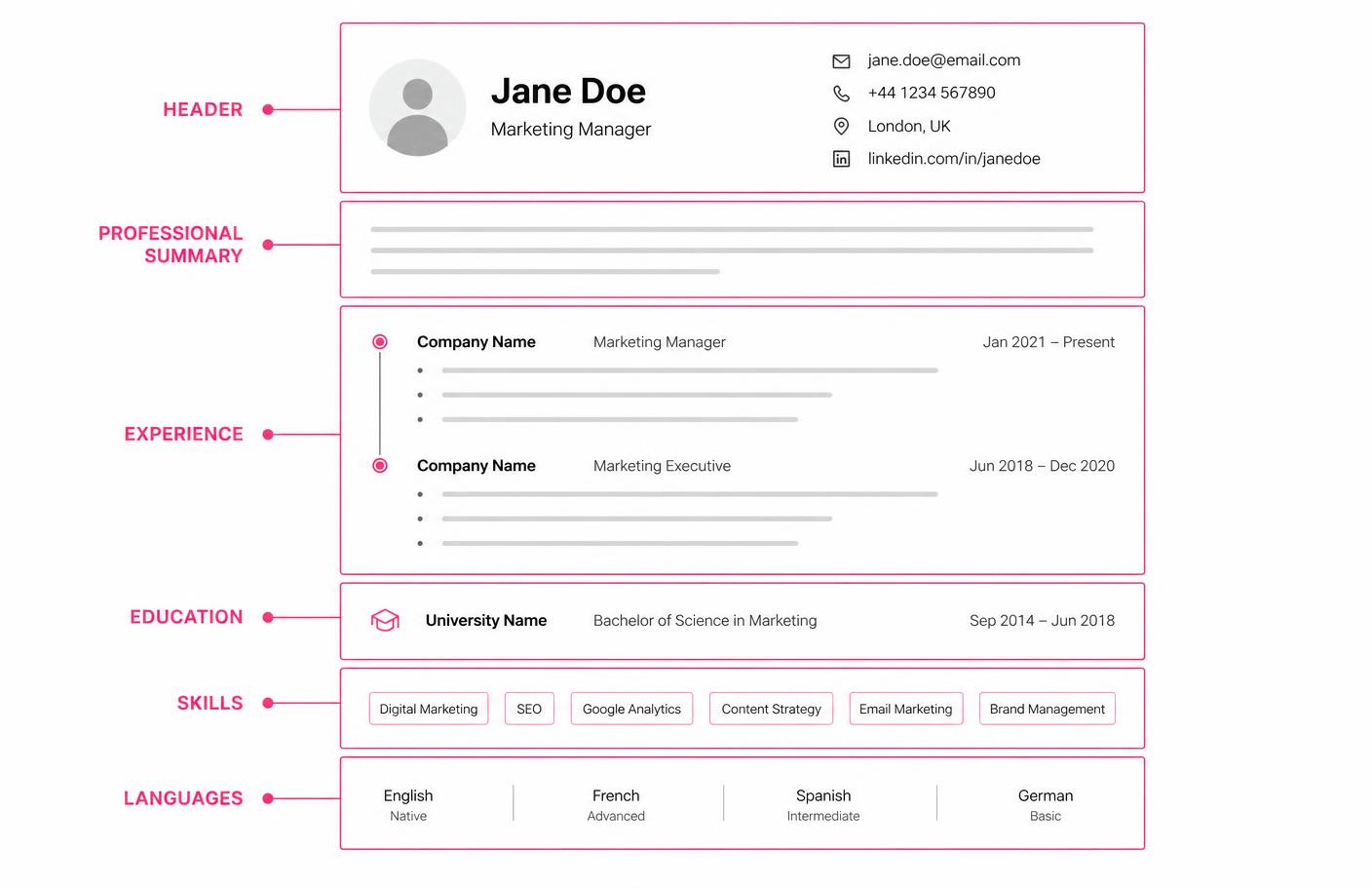
Students with no formal work history should swap the order of blocks 3 and 4 and use a 'Projects' block in place of experience — a documented university, hackathon or volunteering project with a result is stronger than an empty section.
- 11. Header
Full name, one-line role headline matching the advert, city and country, phone with international prefix, professional email, LinkedIn URL, and a portfolio or GitHub link if relevant. No full postal address, no date of birth.
- 22. Professional summary
Three lines, maximum 60 words. Who you are, your strongest two skills with proof, and what you are looking for including availability dates. Rewrite it for every application.
- 33. Experience
Reverse chronological. Internships, part-time jobs, freelance work, volunteering and significant university projects all count. Three to five achievement bullets for the most relevant role, two for the rest.
- 44. Education
Degree, institution, city, dates, and grade only if it is strong. Add two lines for the most relevant modules or a thesis title when experience is thin.
- 55. Skills
Split into hard skills (tools, software, methods) and languages with CEFR levels. Skip generic soft-skill lists — prove those in the experience bullets instead.
- 66. Extras
Certifications, publications, competitions, societies, driving licence if the job needs it. Cut anything that does not support this specific application.
Write bullets that show results, not duties
This is where most student CVs are lost. A duty describes the job description; an achievement describes what changed because you were there. Use the formula: action verb + task + tool or method + measurable result.
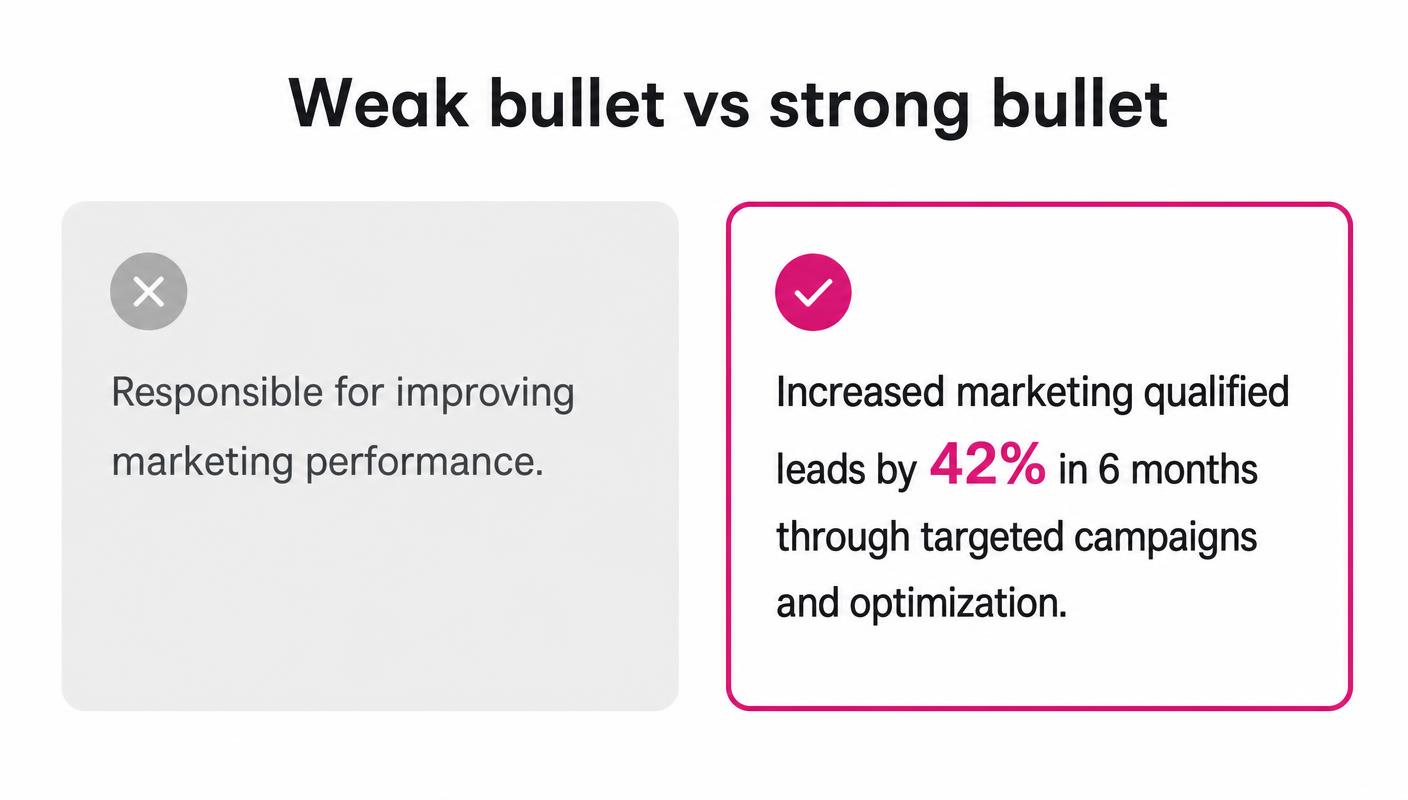
- Weak: 'Responsible for social media.' Strong: 'Planned and published 12 posts a month across Instagram and LinkedIn, lifting average engagement rate from 1.8% to 3.1% over one semester.'
- Weak: 'Helped customers in a restaurant.' Strong: 'Served up to 90 covers per shift in a 60-seat restaurant and trained two new staff members on the POS system.'
- Weak: 'Worked on a website.' Strong: 'Built a React front end for a university society site used by 400 members, cutting event sign-up time from 5 minutes to under 1.'
- Weak: 'Did data analysis.' Strong: 'Cleaned and analysed a 12,000-row sales dataset in Python (pandas) and produced a Power BI dashboard adopted by the sales team.'
No numbers available? Quantify scale instead of impact: team size, number of customers, frequency, budget, volume, languages used, tickets handled per week. Any concrete figure beats an adjective.
Beating the ATS without gaming it
Applicant tracking systems parse the CV into structured fields and score keyword overlap with the advert. They fail on visual tricks, not on honest formatting. The goal is to be parsed correctly, not to stuff keywords.
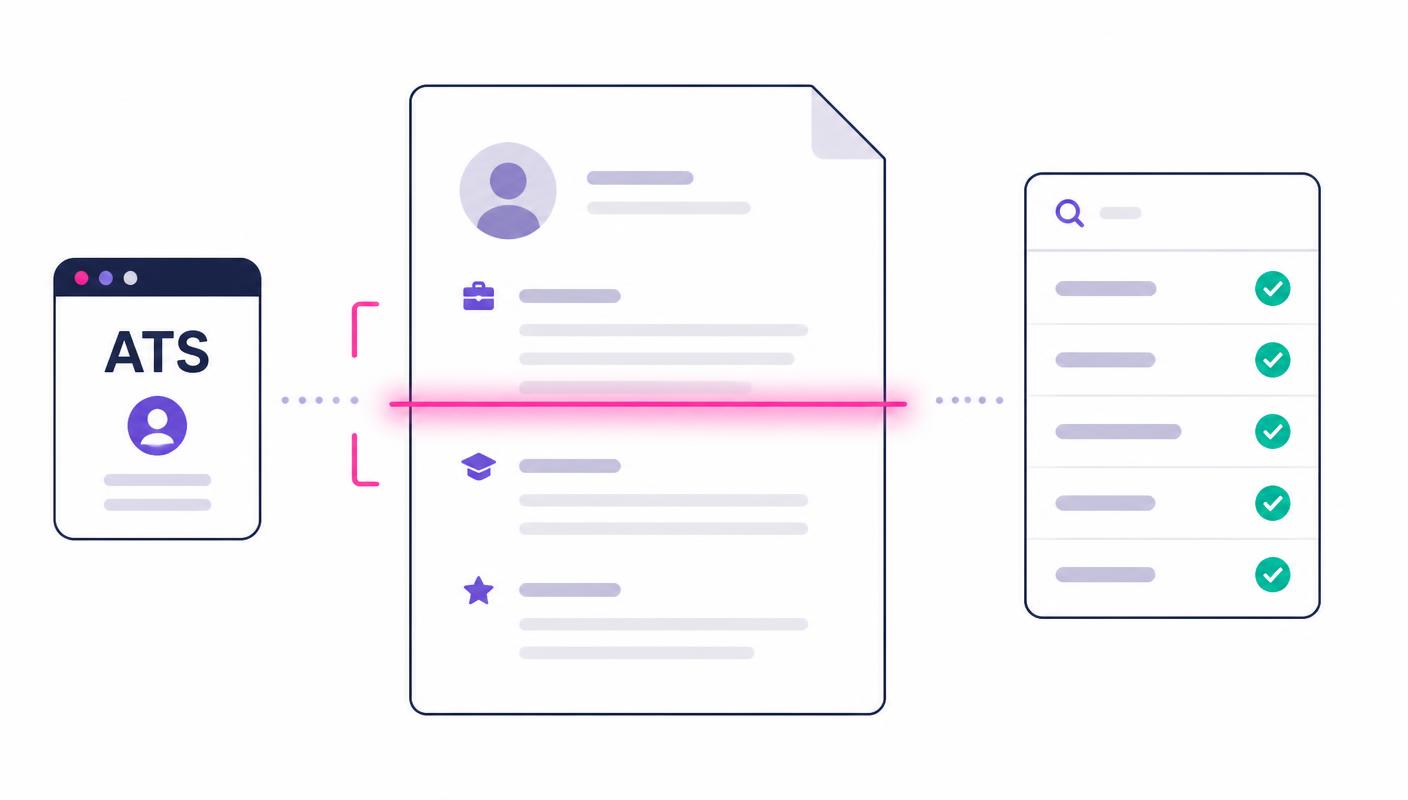
- Use one column. Two-column templates frequently interleave the text and scramble the parse.
- Use standard headings: Experience, Education, Skills, Languages. Creative headings like 'My journey' are not mapped to fields.
- Keep contact details in the body, not in the document header or footer — many parsers ignore those regions.
- Avoid tables, text boxes, icons carrying meaning, and any text rendered inside an image.
- Mirror the advert's exact terms. If it says 'B2B lead generation', write 'B2B lead generation', not 'business client acquisition'.
- Spell out acronyms once: 'Search Engine Optimisation (SEO)' matches both queries.
- Save as PDF from a text editor (not a scan or screenshot) unless a .docx is requested, and name the file Firstname-Lastname-CV.pdf.
A fast self-test: copy the whole CV, paste it into a plain text file, and read it. If sections are jumbled, dates detached from employers, or contact details missing, the ATS is seeing the same mess.
Tailoring in 15 minutes per application
Sending the same CV to 40 employers is the least effective strategy available. Tailoring does not mean rewriting from scratch — it means a repeatable 15-minute pass on a master CV.
Keep a master document with every bullet ever written, including the ones that get cut. Tailoring then becomes selection rather than composition, and quality stays constant across applications.
- 1Minutes 1–4: extract requirements
Copy the advert into a document and highlight every hard skill, tool and responsibility. The first three listed are usually the ones being scored.
- 2Minutes 5–8: rewrite the headline and summary
Match the advert's job title exactly in the headline. Name the two highlighted skills you can prove in the summary, with a number.
- 3Minutes 9–12: reorder and re-word bullets
Move the most relevant role to the top of Experience and rewrite its bullets using the advert's vocabulary. Cut unrelated bullets rather than adding new ones.
- 4Minutes 13–15: sync skills and file name
Align the Skills block with the advert's tool list (only tools you can actually use), re-export the PDF, and rename it for this employer's records.
No experience yet? Part-time jobs, sport and student societies are experience
The most common blocker we hear from students is 'I have nothing to put on it'. Almost always they do — they simply filed it under 'not real work'. A waiting shift, a football team, a class rep mandate and a volunteering weekend all produce the same evidence an employer is looking for: reliability, teamwork under pressure, responsibility for something that mattered to other people. What changes is how you write it.
Put these under a heading the parser understands. If you have any paid or formal role, keep 'Experience' and add the rest under 'Projects & activities'. If you have none, rename the block 'Relevant experience' and place it directly under the summary — it is the recruiter's first stop, so it should not sit at the bottom of the page.
| What you did | What it proves | How to write it on the CV |
|---|---|---|
| Waiting tables, barista, retail, call centre | Customer handling, speed, working in a rota, cash accuracy | 'Served up to 90 covers per weekend shift in a 60-seat restaurant; trained 2 new staff on the POS system.' |
| Team sport (football, basketball, rowing, athletics) | Commitment over time, teamwork, coachability, discipline | 'Competed in the regional university league for 3 seasons, training 8 hours a week alongside full-time study; captained a 14-player squad in the final season.' |
| Club, society or student union role | Ownership, budgets, events, communication | 'Treasurer of a 220-member student society: managed a €4,800 annual budget and cut event costs 18% by renegotiating two supplier contracts.' |
| Volunteering (association, NGO, local event) | Initiative, values, working with the public | 'Volunteered 6 hours a week for one academic year at a local food bank, coordinating a rota of 12 volunteers.' |
| Class representative / peer mentor | Representation, negotiation, mentoring | 'Elected class representative for 60 students; collected feedback each term and presented 3 curriculum proposals to faculty staff.' |
| Family business, freelance gigs, tutoring | Real responsibility, client work, autonomy | 'Tutored 5 secondary-school students weekly in mathematics; all 5 passed the end-of-year exam.' |
| Coursework, hackathons, capstone projects | Applied technical skill with a deliverable | 'Built a 3-person capstone project in Python analysing 12,000 rows of open transport data; presented results to a panel of 4 lecturers.' |
| Erasmus+ exchange, summer school, language stay | Adaptability abroad — exactly what host supervisors screen for | 'Completed a 5-month Erasmus+ exchange in Seville studying in Spanish (reached B2, DELE certified).' |
The photo question: when a CV picture helps and when it kills the application
This is the single most-asked question in our placement sessions, and the answer is geographic rather than aesthetic. A photo is neutral-to-positive in parts of continental Europe and actively harmful in others, because anti-discrimination policy in some countries obliges recruiters to discard CVs containing personal images.

- If you include one: head and shoulders, eyes level with the camera, neutral background, daylight from the front, plain top in a solid colour, small and square in the top corner (roughly 3.5 × 4.5 cm).
- Take it against a white wall near a window with a phone on a stack of books — a timer shot at eye level beats a held-out arm every time. No flash, no filters, no beauty mode.
- Crop tight: chin to just above the head, shoulders visible. A full-body or holiday crop reads as unserious.
- Never use a selfie, a cropped group photo, sunglasses, a party background, or a picture more than two years old.
- Keep the photo as an image placed in the document — but always keep a photo-free version of the same CV for ATS uploads and for UK/US applications.
- Use the same photo on LinkedIn. Recruiters cross-check, and matching visuals make you easier to remember after a shortlist meeting.
| Destination | Photo | Why |
|---|---|---|
| UK, Ireland | No | Recruiters are advised to reject CVs with photos to avoid discrimination claims. |
| USA, Canada (J-1 applications) | No | A résumé carries no photo, date of birth, nationality or marital status. |
| Spain, Italy, Portugal, France | Optional, common | Widely accepted; a bad photo still hurts more than no photo. |
| Germany, Austria, Switzerland | Optional, still frequent | Traditional 'Bewerbungsfoto' culture, though photo-free applications are now normal. |
| Netherlands, Nordics | Usually no | Neutral to negative; skills-first culture. |
| Any ATS upload field | No | Images are not parsed and can break the layout the parser sees. |
Languages, mobility and international sections
For students applying abroad, three blocks carry disproportionate weight because they answer the host company's real anxieties: can this person communicate, can they legally start, and when.
- Languages: always use CEFR levels (A1–C2) plus one line of proof — 'Spanish B2 (DELE, 6-month exchange in Seville)'. 'Fluent' means nothing without context.
- Availability: state the exact window, for example 'Available 1 February – 31 July 2027 (6 months, Erasmus+ funded)'. Host companies filter hard on dates.
- Legal status: one short line — 'EU citizen, no work permit required' or 'Erasmus+ traineeship agreement, visa support required'. It removes a screening question.
- International exposure: exchanges, summer schools, volunteering abroad and multilingual teamwork belong on the CV; they predict adaptation, which is what host supervisors worry about.
- CEFR
- Common European Framework of Reference for Languages — the A1 to C2 scale used across Europe to describe language proficiency.
- Learning Agreement for Traineeships
- The tripartite Erasmus+ document signed by student, sending institution and host that fixes the tasks and dates of the placement.
- Europass
- The European Commission's free CV and skills platform, useful for structure and for storing certificates.
Design, length and the details that get noticed
Design should be invisible. Its only job is to make the evidence easy to find in six seconds.
- One page for students and graduates with under five years of experience. Two pages is a decision, not an accident.
- One clean sans-serif font at 10–12pt for body text; margins no smaller than 1.5cm; consistent 1.15 line spacing.
- One accent colour maximum, used only for section headings.
- Consistent date format throughout — 'Mar 2025 – Aug 2025', never mixed with '03/2025'.
- No photo, date of birth, marital status or nationality for UK, Ireland and US applications. In parts of continental Europe a photo is still common; when in doubt, omit it.
- Proofread out loud, then have someone else read it. A single typo in the first three lines is the fastest disqualifier there is.
“A recruiter is not looking for reasons to hire you on the first pass. They are looking for reasons to stop reading. Remove them.”
Free tools and resources worth using
A short, curated list beats a directory. These are free, and each solves one specific problem in the process.
Two free checks cost nothing and catch most problems: paste the CV into a plain text file (the cheapest ATS simulator there is), and book a review with your university careers service — most run them and most students never use them.
- Europass CV editor
Free European Commission editor. Exports PDF and .docx and stores your certificates — best used for structure, then rewritten into a one-page layout.
- ESCO occupation and skills vocabulary
Look up your target occupation and reuse the exact skill terms European employers and ATS filters are built around.
- Canva CV templates
Fast, good-looking one-page layouts for direct applications and photo versions. Pick a single-column template, and export a plain text-based PDF for any ATS upload.
- Google Docs template gallery
Free single-column, text-based templates that survive ATS parsing better than most graphic-design files.
- EURES — applying for a job in Europe
Official country-by-country rules on application documents, including where photos and personal data are expected.
- LinkedIn profile checklist for students
Align headline, dates and job titles with the CV — recruiters cross-check within minutes of shortlisting.
- Piktalent internship programmes
Once the CV is ready, this is where it goes: vetted host companies across Europe and the USA, with CV review included in our placement service.
Final pre-send checklist
Run this list before every submission. It takes three minutes and catches the failures we see most often in placement applications.
- The headline names the exact role from the advert.
- The summary contains at least one number and the availability window.
- Every experience bullet has an action verb and a result or a scale figure.
- The advert's top three hard skills appear in the CV, in the advert's own words.
- One column, standard headings, no text inside images, contact details in the body.
- One page, consistent dates, no typos in the first three lines.
- File exported as PDF and named Firstname-Lastname-CV.pdf.
- LinkedIn profile matches the CV, and the linked portfolio actually opens.
A CV never gets anyone hired on its own — it buys a conversation. Optimise it for that single outcome and the rest of the application process becomes far easier.
Continue reading on Piktalent
Frequently asked questions
Continue exploring
Pages on the Piktalent site that go deeper on the topics covered above.
Internship fields mentioned here
Related guides and resources
- Internship programmes for studentsWhere to apply once the CV is ready.
- Premium placement servicesOne-to-one CV review and interview preparation with our placement team.
- How to apply for an Erasmus+ internship in 2026The full application sequence your CV feeds into.
- How to find an Erasmus internship placementWhere to send the tailored CV.
- What is a training agreement?The document that follows a successful application.
References
Official sources cited in this article. All links open in a new tab.
- Europass — Create your CV — European Commission
- ESCO — European Skills, Competences and Occupations — European Commission
- Common European Framework of Reference for Languages (CEFR) — Council of Europe
- EURES — Working abroad: applying for a job — European Labour Authority
- Erasmus+ Programme Guide 2026 — European Commission
About the authors
Piktalent Editorial — Erasmus+ mobility practitioners since 2009
This guide is written by the Piktalent editorial and placements team. Piktalent is the mobility brand of The Student Mobility Group, which has organised international internships and Erasmus+ traineeships since 2009. We place students with host companies across Europe and the USA, sign the learning agreements, vet the hosts and support participants on the ground — so the procedures described here are the ones we run ourselves, not a summary of other websites.
Why we can write about this
- •Operating since 2009 as The Student Mobility Group; Piktalent since 2023.
- •Erasmus+ KA131, KA171, KA121 and KA122 mobilities handled end to end for sending institutions.
- •Host-company vetting, learning agreements, accommodation, insurance and in-country support in 30+ countries.
- •Direct daily contact with national agencies, host employers, universities and VET providers.
How this article is verified
- •Every factual claim is checked against a primary source — EU institutions, national agencies, ministries or official statistics — before publication.
- •Figures, fees and deadlines are re-checked at the verification date shown at the top of the article.
- •Procedures are cross-checked against the cases our placements team handled in the last 12 months.
- •Corrections are welcome: write to us and we update the guide with the date changed.
Institutional sources we work from
The official references behind our careers, skills and mobility guidance. Each opens on the issuing institution's own domain.
- ESCOEuropean skills & occupations classification
- EuropassOfficial CV and skills profile tools
- CEFRCouncil of Europe language levels (A1–C2)
- EURESLiving and working conditions across Europe
- EurostatEmployment statistics for recent graduates
- Erasmus+ Programme GuideRules, eligibility and funding for every key action
Need help running a real Erasmus+ mobility?
We deliver host search, contracts, accommodation and 24/7 support end-to-end.