Europe’s labour market is transforming at speed. Digitalisation, remote collaboration, AI-enabled workflows, and multicultural teams are no longer “future trends”—they are standard in many workplaces. Across sectors, employers increasingly prioritise transferable, future-proof skills alongside technical expertise.
By 2026, what differentiates early-career candidates is not only what they studied, but how quickly they adapt, communicate, learn and deliver in real environments. In this landscape, international mobility—Erasmus+ internships, VET mobilities and job-shadowing programmes—has become one of the most effective ways to accelerate skill development in a measurable, career-relevant way.
Why mobility matters: employers expect skills needs to keep shifting quickly through 2030, making adaptability, analytical thinking and digital fluency more valuable than static qualification checklists.
— Based on global employer insights and EU skills priorities
What you’ll learn
- The skills most employers prioritise as Europe approaches 2026.
- Why transferable skills now matter as much as technical knowledge.
- How mobility experiences build these skills faster than classroom-only routes.
- How universities and VET centres can turn mobility into an employability advantage.
- What host companies gain from welcoming international interns.
- A practical “mobility-to-skills” framework you can use in programme design.
- A checklist students can follow to prove skills on their CV and interviews.
- Reliable sources and reports to support institutional decision-making.
The changing face of Europe’s workforce
Europe’s skills agenda is strongly shaped by the “twin transition”: digital transformation and the green transition. Labour market forecasts emphasise growing demand for higher-level skills in technology, services, and roles that combine technical knowledge with communication and problem-solving.
What employers increasingly look for:
People who can learn fast, work across cultures, handle digital tools confidently, and contribute to teams solving real operational problems.
What this means for students:
Real-world experience that proves behaviour and delivery in complex environments becomes a major hiring signal.
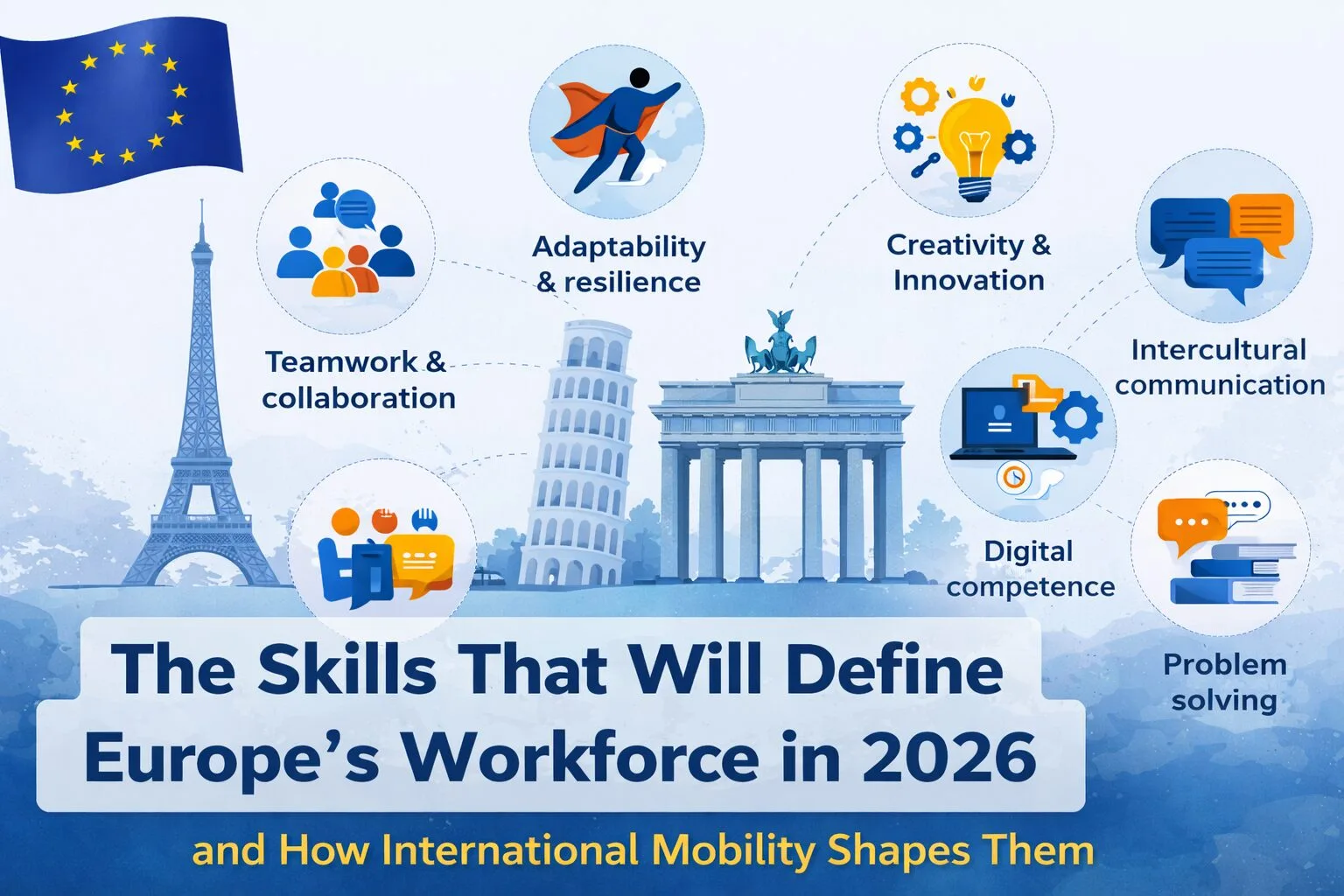
The skills that will define Europe’s workforce in 2026
Across major reports and EU priorities, the same skills appear repeatedly as critical for employability and productivity:
- Adaptability and resilience – adjusting quickly to change, uncertainty and new contexts.
- Intercultural communication – working effectively across cultures and work styles.
- Digital literacy – using digital tools, platforms and tech-first workflows with confidence.
- Analytical thinking & problem-solving – making decisions with limited data and practical constraints.
- Teamwork and collaboration – contributing to distributed, cross-functional teams.
- Language proficiency – especially English; additional languages add sector-specific advantage.
- Creativity and innovation – improving processes, proposing ideas, testing solutions.
- Self-management and initiative – ownership, time management, accountability.

Why international mobility develops these skills faster
A mobility experience abroad is not “travel plus work.” It is an immersive training process where students apply professional behaviours in a new environment—often with different workplace expectations, communication styles, and operational realities.
Mobility-to-skills map (how it works in real life)
- Adaptability & resilience
Students navigate a new country, new routines, and new workplace methods. They develop confidence under uncertainty and learn to respond productively to change. - Intercultural communication
Daily collaboration with international colleagues and supervisors builds clarity, empathy, and communication discipline—skills that directly impact performance in modern teams. - Digital competence
Internships increasingly rely on digital platforms for coordination, reporting, task management and remote collaboration. Students build fluency with workplace tools and digital-first habits. - Problem-solving
Real constraints appear: operational issues at work, documentation processes, and practical living challenges. Mobility pushes students into proactive, solution-oriented thinking. - Teamwork in international contexts
Students contribute to teams where norms differ. They learn to align expectations, communicate progress, and deliver reliably across cultural styles. - Language development
Language shifts from theory to functionality. Students practice professional vocabulary daily and gain confidence through repeated real interactions. - Creativity & innovation
Exposure to different methods and perspectives helps students notice alternatives. They often propose small improvements, new ideas, or better ways of working. - Self-management & initiative
International placements reward autonomy. Students learn how to set priorities, meet deadlines, and take ownership—behaviours employers consistently value.
Impact: what mobility delivers for each stakeholder
For students
- Stronger confidence and independence.
- Sharper communication and teamwork behaviours.
- A CV signal employers understand immediately.
- New networks and clearer career direction.
For institutions
- Higher employability outcomes and satisfaction.
- Alignment with European skills priorities.
- Stronger international partnerships.
- More attractive academic and VET offering.
For host companies
- Motivated interns with fresh perspectives.
- Support for daily operations and projects.
- Access to an international talent pipeline.
- Stronger intercultural capability in teams.
Quick Wins: how students can prove these skills after mobility
- Write 3 measurable achievements (time saved, output delivered, customer impact).
- List digital tools used (CRM, project management, spreadsheets, POS, etc.).
- Document one challenge and the action taken to solve it.
- Prepare two intercultural collaboration examples for interviews.
- Ask the supervisor for a structured reference letter.
- Convert tasks into outcomes (not “assisted”; explain what improved).
- Show initiative: improvements suggested, processes optimised, ideas tested.
- Add language proof: tasks performed in English/Spanish/other language.
- Create a short portfolio (screenshots, reports, project notes).
- Build a professional LinkedIn summary using mobility keywords.
Related reading (internal)
If you manage Erasmus+ mobilities and compliance, you may also find this useful: Spain Social Security for Erasmus Internships (2026 Update) .
How Piktalent supports mobility that builds employability
International mobility delivers the strongest results when the experience is structured: clear learning outcomes, real tasks, mentoring, and proper documentation. If you are designing a mobility programme, these pages can help:
- Erasmus+ Mobility Support
- Internships Abroad for Students
- Host International Interns (for Companies)
- VET Mobility Programmes
FAQ
Are these skills relevant outside tech sectors?
Yes. Hospitality, healthcare, logistics, tourism, manufacturing, administration and education all increasingly require digital tools, multicultural communication and adaptable teamwork.
Does mobility help if a student is shy or lacks confidence?
Often more than any classroom format. Mobility creates repeated low-stakes practice in real interactions, which steadily builds confidence and communication strength.
What makes mobility “high quality” for skills development?
Clear learning objectives, meaningful tasks, supervisor feedback, documented outcomes, and a structure that links experience to employability.
Sources and recommended reading
- World Economic Forum — The Future of Jobs Report 2025 (skills change through 2030)
- WEF — Future of Jobs Report 2025 (PDF)
- European Commission — European Skills Agenda
- European Commission — Digital Skills & Digital Decade targets
- Cedefop — Skills forecast 2035: twin transition and demographics
- Cedefop — Skills Forecast tool (EU employment and skills outlook)
- OECD — Skills Outlook 2023 (skills, resilience and transitions)