Is International Mobility Still Worth It in 2026?
Let’s address the question everyone is quietly Googling:
“Is studying abroad worth it in 2026?”
Between rising living costs, AI transforming jobs, and your cousin who says “You can just do everything online now,” it’s fair to ask:
Does international mobility still deliver real ROI?
Short answer: yes.
Long answer: let’s look at the numbers — and have some fun while we do it.
The Big Question: Does Erasmus Improve Salary?
According to the European Commission Erasmus+ Impact Studies, graduates with international mobility experience show:
- Higher employment rates within 12 months
- Greater international career mobility
- Higher likelihood of working in managerial roles
- Improved soft skills valued by employers
Now let’s translate that into something everyone understands: money.
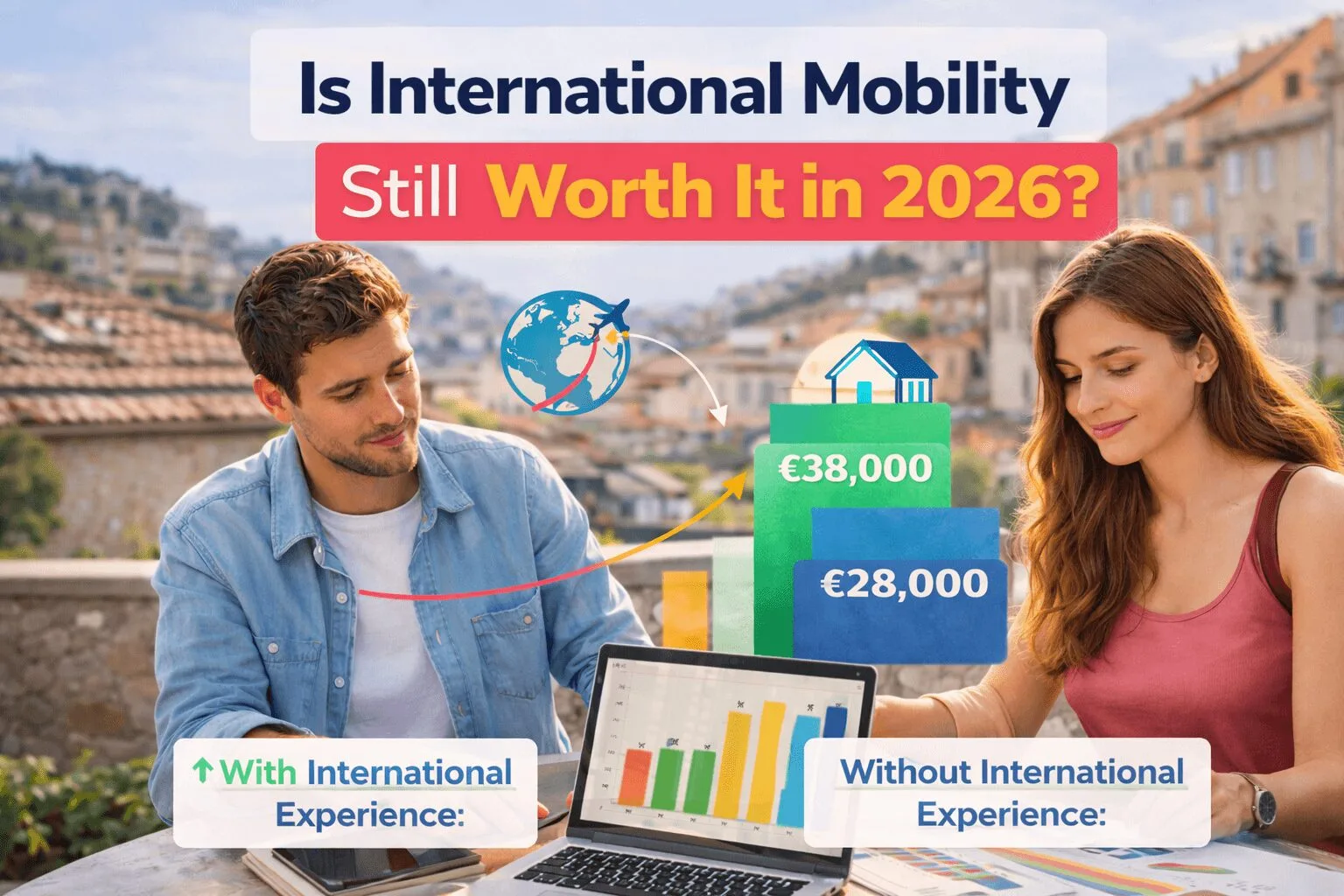
Salary Projection: With vs Without International Experience
| Profile | Average Starting Salary (EU estimate) | 5-Year Progression Potential |
|---|---|---|
| Graduate without mobility | €22,000 – €28,000 | Standard progression |
| Graduate with Erasmus/international internship | €25,000 – €32,000 | Higher likelihood of international or managerial roles |
Sources include aggregated data from Eurostat, the OECD Youth Employment Outlook, and Erasmus+ evaluation reports (2023–2024 updates).
International Internships ROI: Let’s Break It Down
Return on Investment (ROI) isn’t just for business schools. Let’s calculate mobility ROI like adults (but fun adults).
Costs
- Travel and accommodation (often subsidised by Erasmus+)
- Temporary relocation expenses
- Possibly a few extra espressos
Returns
- Higher employability rates
- Salary premium over time
- Access to international labour markets
- Expanded professional network
- Enhanced soft skills
According to the World Economic Forum Future of Jobs Report 2023, adaptability, cross-cultural communication and problem-solving are among the most demanded skills in 2026 and beyond.
Mobility builds those skills faster than sitting at home watching productivity videos.
But What About AI? Isn’t Everything Remote Now?
Yes, AI is transforming work. No, it doesn’t eliminate the value of mobility.
According to the OECD Employment Outlook 2023, human skills such as collaboration, adaptability, and intercultural competence are becoming more valuable — not less.
AI can optimize spreadsheets. It cannot replace:
- Working in a multicultural team
- Adapting to unfamiliar business environments
- Handling real-time cross-cultural negotiation
- Building global professional networks
In other words, AI can schedule the meeting. International mobility teaches you how to run it.
What Employers Actually Say
Surveys from Erasmus+ programme evaluations and employer feedback consistently show that graduates with mobility experience are perceived as:
- More independent
- More proactive
- More adaptable
- More confident in international environments
And in a globalised labour market, that perception matters.
Myth vs Reality
Myth: Studying abroad is just a travel experience.
Reality: Erasmus+ impact data shows long-term employability gains.
Myth: It’s too expensive.
Reality: Erasmus+ provides financial support, reducing mobility barriers.
Myth: It doesn’t affect salary.
Reality: Mobility graduates demonstrate faster career progression in multiple EU studies.
International Mobility in 2026: Strategic Advantage
In 2026, mobility isn’t just about studying abroad. It’s about positioning yourself in a competitive global labour market.
According to Cedefop, European labour markets increasingly value cross-border competence and mobility readiness.
Institutions that integrate structured internships abroad into their programmes are offering students measurable long-term advantages.
So… Is Studying Abroad Worth It in 2026?
If your goal is:
- Higher long-term earning potential
- Stronger employability
- International career access
- Future-proof soft skills
- Professional differentiation
Then yes.
International mobility remains one of the highest ROI educational investments available — especially when structured through programmes like Erasmus+.
Final Thought
In 2026, staying local might feel safe.
But stepping abroad is strategic.
Mobility is no longer just an experience — it’s a career accelerator.
If you’re an institution or student exploring structured mobility pathways, talk to Piktalent about building high-impact international internship programmes aligned with measurable outcomes.